Binoculars and Spotting Scopes: A Field Guide to Wildlife Optics
In the dim understory of Costa Rica's Monteverde Cloud Forest Reserve, a pair of 8x42 binoculars reveals the scarlet flash of a Resplendent Quetzal perched 25 meters away without losing the surrounding bromeliads. New watchers often feel overwhelmed by the wall of numbers on every optic, yet understanding magnification, objective diameter, and exit pupil turns confusion into confidence. By 2026 the core principles remain unchanged while glass quality and coatings continue their steady improvement, allowing even mid-tier models to deliver crisp views that once required four-figure investment.
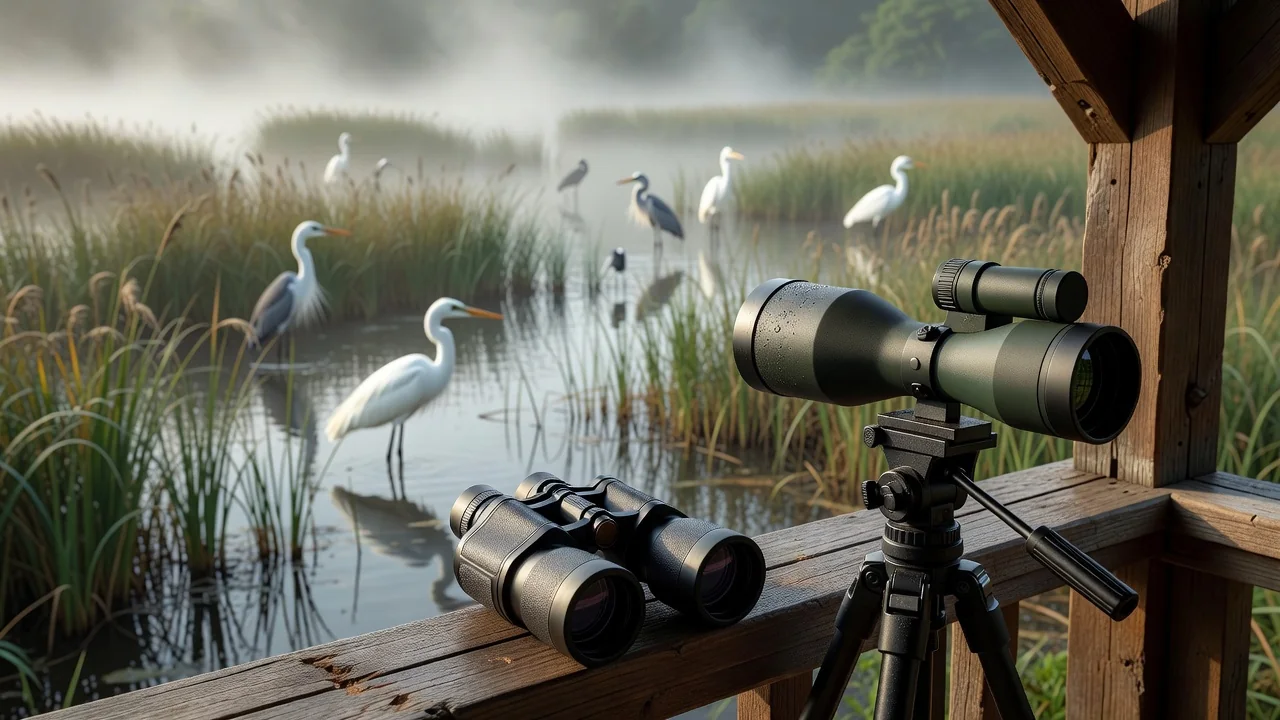
Choosing the right tool means matching the optic to the habitat and the target species. An 8x42 excels when scanning dense foliage for warblers at 15 to 40 meters, while a 10x42 reaches farther across open grasslands to locate a distant coyote or pronghorn. For shorebirds feeding on mudflats 300 meters distant or raptor nests high in a cliff face, a 20-60x spotting scope on a sturdy tripod becomes worth its 1.6 kg burden. The key is knowing when extra power adds detail and when it narrows your view too much.
What the Numbers Actually Mean
The first number in 8x42 is magnification: the bird appears eight times larger than with the naked eye. The second number is the objective lens diameter in millimeters; larger objectives gather more light. An 8x42 therefore has a 5.25 mm exit pupil, calculated by dividing 42 by 8. This size matches the average human pupil in low light, delivering bright images at dawn and dusk when owls and deer are most active. Ten-power binoculars produce a 4.2 mm exit pupil, slightly dimmer but still excellent for most daylight wildlife watching across North American refuges.
Field of view shrinks as magnification rises. An 8x42 typically shows 8.1 degrees, letting you track a fast-moving flock of cedar waxwings through the canopy. The same manufacturer’s 10x42 might deliver only 6.5 degrees, making it harder to find the bird again once it darts behind leaves. For forest birding in places like New York’s Adirondack Park, the wider view of 8x42 outweighs the modest extra reach of 10x.
Low-Light Performance and Exit Pupil
Exit pupil determines how much light reaches your retina. A 7 mm exit pupil is ideal for full darkness, but wildlife observers rarely need that. Most 8x42 models provide enough brightness for spotting black bears at 60 meters during civil twilight in Alaska’s Denali National Park. Coatings on the lenses, especially dielectric prism coatings in mid-tier models, boost light transmission from 85 percent to 93 percent, visibly brightening the image without increasing weight.
Habitat Dictates the Best Choice
In thick woodland or jungle, 8x42 binoculars balance magnification, field of view, and weight at roughly 650 grams. They let you follow a cerulean warbler flitting between branches at 20 meters without constant refocusing. On open prairie or coastal mudflats, 10x42 binoculars give the extra detail needed to distinguish a semipalmated plover from a snowy plover at 120 meters. When distances exceed 250 meters, such as identifying raptors on distant cliffs in Utah’s Zion National Park, a spotting scope with 20-60x zoom and 80 mm objective earns its place in the pack.
Eye Relief, Waterproofing, and Build Quality
Glasses wearers need at least 15 mm of eye relief so the full field of view remains visible without pressing lenses against frames. Most current 8x42 and 10x42 models from reputable brands now offer 16 to 18 mm, a welcome change from older designs. Waterproofing combined with nitrogen or argon purging prevents internal fogging during sudden rainstorms on the Olympic Peninsula or temperature swings in the Grand Canyon. A magnesium-alloy chassis keeps total weight under 700 grams even in mid-tier 10x42 binoculars.
Price Tiers in 2026
Entry-level binoculars priced between 150 and 250 USD, such as the Vortex Diamondback HD 8x42, deliver sharp edges and reliable performance for weekend outings. Mid-tier instruments from 400 to 700 USD add better glass, smoother focus wheels, and higher light transmission, suitable for serious year-round observation in habitats from Florida swamps to Montana foothills. Alpha-level optics above 2000 USD from Swarovski, Zeiss, or Leica provide unmatched color fidelity and edge-to-edge clarity that reveal feather detail on a distant harrier at 400 meters, though the law of diminishing returns applies after the 700 USD mark for most users.
Carrying and Testing in the Shop
A harness spreads the load across both shoulders and prevents the binoculars from swinging during a 10-kilometer hike, while a simple neck strap suffices for shorter walks. Test any binocular by focusing on a small sign 30 meters away, then checking how quickly and smoothly the wheel turns. Look through them at an angle to detect edge distortion, and compare multiple models side-by-side under the store’s fluorescent lights before stepping outside to view real foliage and sky. Reputable retailers allow returns within 30 days if the optic fails in the field.
- The 8x42 format remains the top all-rounder for most North American birders and mammal watchers.
- Spotting scopes justify their weight only when you regularly observe subjects beyond 200 meters.
- Exit pupil above 4 mm ensures usable brightness during the first and last hours of daylight.
- Nitrogen-purged barrels prevent fog even after moving between air-conditioned vehicles and humid forests.
- Harnesses reduce neck strain on hikes longer than five kilometers.
- Side-by-side testing in natural light reveals true differences in color and contrast.
| Feature | Entry (150-250 USD) | Mid (400-700 USD) | Alpha (>2000 USD) |
|---|---|---|---|
| Magnification | 8x or 10x | 8x or 10x | 8x or 10x |
| Weight (g) | 680 | 620 | 580 |
| Light Transmission | 85% | 92% | 95% |
| Eye Relief (mm) | 15 | 17 | 18 |
| Fogproof | Yes | Yes | Yes |
| Warranty (years) | Lifetime | Lifetime | 30 |
Armed with these facts, any beginner can walk into a store in 2026, ignore the hype, and walk out with optics perfectly matched to the wild places they love most.