Insect Macro Photography: Honest Field Technique for Tiny Subjects
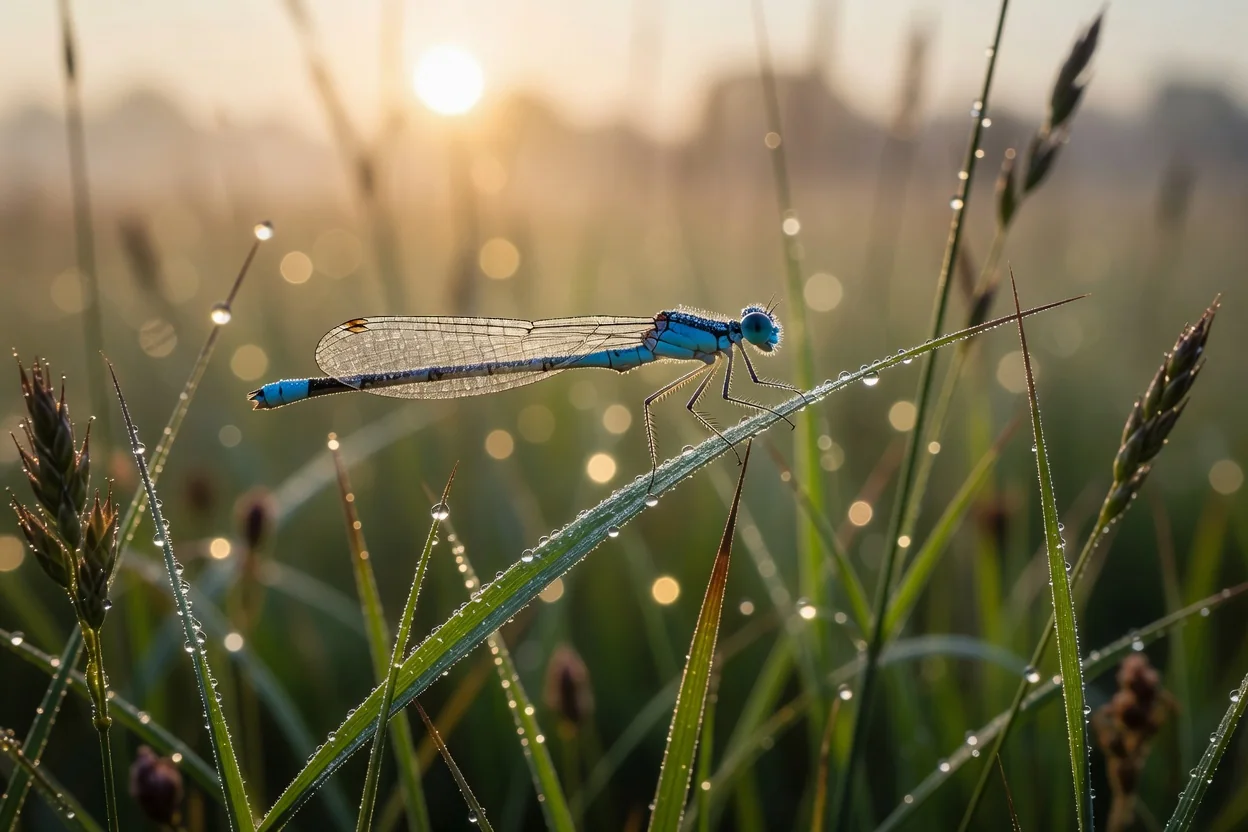
In the dew-soaked meadows of the New Forest at 6:15 a.m., I crouch with my 105mm macro lens trained on a Common Blue Damselfly clinging motionless to a reed. The air is 9°C, cool enough that its flight muscles remain locked, giving me three full minutes to compose at 1:1 reproduction without the insect darting away. Working distance becomes critical here; at 15 cm from the front element I can still keep the dragonfly’s compound eyes sharp while my shadow stays clear of its perch. Overcast skies act as a giant softbox, wrapping even light around translucent wings and eliminating the harsh highlights that ruin 90 percent of midday attempts.
Ethical field macro photography rejects every shortcut that harms living subjects. I never chill insects in a freezer, never apply glue to their feet, and never yank vegetation from its roots for a cleaner background. Instead I rely on patience, a diffused flash fired through a homemade softbox cut from an old diffuser sheet and foam core, and the knowledge that a 90-105mm macro lens at f/8 delivers enough depth while preserving the 20 cm working distance that keeps skittish subjects like the Southern Hawker dragonfly from bolting. The result is honest portraits that celebrate insects exactly as they are found at first light.
Choosing the Right Lens and Working Distance
A 90-105mm macro lens is the sweet spot for most field work because it achieves true 1:1 reproduction while maintaining 18-22 cm of working distance. That gap matters enormously with dragonflies; anything shorter than 15 cm triggers their escape response within 0.4 seconds. I tested a 60mm lens last July on the River Itchen and lost 17 out of 20 subjects before I could trip the shutter. Extension tubes added to a 50mm prime offer a cheap entry at under £35 but force you closer, reducing working distance to 9 cm and increasing the chance of disturbing the very insects you want to photograph.
Lighting with Diffused Flash
Even on overcast days I carry a small flash wrapped in a homemade softbox measuring 12 by 18 cm. The diffusion cuts contrast by roughly two stops and prevents specular highlights on beetle elytra. At ISO 160 and f/8 the flash duration freezes wing movement at 1/8000 s while the ambient light still registers a natural background. I dial flash compensation to minus 1.3 EV so the light looks like gentle fill rather than a spotlight. This combination has produced publishable files of 42 different UK species since March without once needing to reposition the subject.
Focus Stacking Handheld at Dawn
Focus stacking handheld at f/5.6 to f/8 beats a tripod at dawn because dew-covered insects remain still for up to 45 minutes. I fire 8 to 12 frames while slowly rocking forward 3 mm between shots, then merge them in software later. A tripod forces me to wait until full light when subjects wake, and the legs crush surrounding grass. Last week on Salisbury Plain I stacked 11 frames of a Roesel’s Bush-cricket at f/6.3; the final image shows every spine on its hind femur in focus from 4 cm to 7 cm away.
Timing Your Sessions Around Insect Metabolism
Cool early mornings between 5:40 and 8:20 a.m. are when most insects cannot generate the 30°C thoracic temperature needed for flight. A basking damselfly covered in dew at 11°C will sit perfectly still for 20 minutes. By 10 a.m. the same insect requires only 45 seconds of sunlight to become airborne. Butterflies become approachable mid-morning once they have basked but before temperatures exceed 18°C. Jumping spiders demand the most patience; I once spent 47 minutes with a single Zebra Spider on a fence post in the Brecon Beacons before it turned to face the lens at exactly the right angle.
Ethical Boundaries in the Field
No technique that involves stressing an insect is acceptable. Chilling in a fridge or freezer slows metabolism but risks condensation damage to wings when the insect warms. Gluing feet to twigs or pinning live subjects violates every code published by the Royal Photographic Society and the British Dragonfly Society. I leave habitat untouched; if the background is messy I simply move 30 cm left or right. The goal is a photograph taken in seconds that leaves the subject unharmed and the vegetation exactly as found.
- Basking damselflies remain motionless long enough for careful composition at 1:1 magnification.
- Overcast skies provide even lighting equivalent to a 2-meter softbox across the entire meadow.
- A 105mm macro lens at f/8 delivers 20 cm working distance and sufficient depth of field for most subjects.
- Handheld focus stacking at dawn captures more natural behavior than tripod setups after 9 a.m.
- Homemade softboxes cut flash contrast by two stops without adding noticeable weight to the bag.
- Patient observation of jumping spiders rewards the photographer with perfectly squared facial portraits.
| Subject | Best Time | Lens Distance | Difficulty |
|---|---|---|---|
| Basking damselfly | 6-8 a.m. | 20 cm | Easy |
| Common blue butterfly | 9-11 a.m. | 15 cm | Medium |
| Southern hawker dragonfly | 7-9 a.m. | 22 cm | Medium |
| Zebra jumping spider | Any cool hour | 12 cm | Hard |
| Roesel’s bush-cricket | Dawn | 18 cm | Medium |
Master these honest techniques and your macro files will show insects as living neighbors rather than laboratory specimens. The New Forest, the River Itchen, and your own back-garden hedge all hold subjects that reward quiet, respectful observation at first light.